1. Introduction
1.1. Rationale and Bangladesh context
An increase in photosynthetic carbon uptake is a potential way to increase crop productivity, but a higher rate of leaf carbon uptake does not imply that there is necessarily a greater benefit in the form of grain yield under environmental stress. The rates of source activity and resource availability, as well as the conversion of assimilated carbon into harvested product are at different biological scales. When selecting engineering targets and interpreting effects on physiology, a systems approach is thus required. This is especially important for C4 crops – enhancing the concentration of CO2 around Rubisco is beneficial for efficient assimilation, but coordinated metabolism and transport between the bundle sheath and the mesophyll cells remain essential functions (Ermakova et al., 2020).
The problem can be illustrated in the context of agriculture in Bangladesh. The sensitivity of irrigation scheduling and nitrogen supply on maize responses was investigated under local evidence by a published experiment in Gazipur. Bangladesh is also involved in the development and deployment of maize for hot, dry conditions in South Asia through regional breeding efforts (Zaidi et al., 2023). These sources do provide a reason for targeting Bangladesh without making the assumption that findings from “controlled environment” plants elsewhere are necessarily representative of Bangladeshi farms. Care must be taken in interpreting the physiological significance of water-use improvement. Stomatal closure is caused by drought and can both reduce water loss and carbon entry as well as evaporative cooling.
Under combined heat and water stress, those functions can pull crop performance in different directions. The sorghum experiment showed that CO⁻ concentration and
water supply and heat influenced the photosynthesis and thermoregulation in an interactive manner (Al-Salman et al., 2023). Field experiments also reveal reduced maize canopy temperature under heat stress (Jian et al., 2024) as a result of supplemental irrigation. Thus a leaf-level ratio will not replace crop water productivity or yield stability. There is an additional constraint, that of dynamic light. Photosynthetic adjustment to changes in irradiance is not immediate and the relative significance of stomatal, biochemical and photoprotective processes varies with the conditions of measurement (Long et al., 2022). Meanwhile, advances in C4 engineering have made it clear that each biochemical or developmental element can be changed. Although these developments do not deem every component change to be a complete carbon-concentrating system or a tested stress-resilience intervention, as yet (Furbank et al., 2023; Liu & Cheng, 2024).
1.2. Research gap and scope
This study is a combination of a reproducible physiological reanalysis and a separate reanalysis of Bangladesh field treatment means. The contribution is an explicit linkage between the statistical unit, the strength of the response measured and the extent of the resulting engineering claim. The analyses quantify carbon–conductance coupling and yield contrasts according to management. A bounded literature synthesis then helps to clarify how multi-omics and dynamic- light biology and field evidence relate to those results. The “field validation” in the research framing is the "proof" necessary to make the translation, and the present field set provides “context” for agronomic processes, not validation for a newly invented genotype.
2. Literature Review
2.1. Biochemical and anatomical engineering
Engineering native C4 crops and installing C4 traits in rice are related but distinct objectives. Overexpression of Rubisco subunits together with RAF1 increased Rubisco content in maize, establishing the importance of assembly capacity alongside enzyme expression (Salesse-Smith et al., 2018). Increasing the Rieske FeS protein raised cytochrome b6f content and improved C4 photosynthesis in Setaria viridis, identifying electron transport as another manipulable limitation (Ermakova et al., 2019). Conversely, assembled Rubisco expressed in maize mesophyll cells did
not necessarily contribute measurably to assimilation, showing why protein abundance alone is an incomplete functional endpoint (Hotto et al., 2021). Rice engineering illustrates the coordination problem at a broader scale. A single construct enabled expression of five C4 pathway enzymes, but the resulting metabolic flux remained far below that of maize (Ermakova et al., 2021). Developmental work has recreated part of the transition toward C4-like leaf anatomy (P. Wang et al., 2017), while more recent studies distinguish the identities of major and minor vein initiation and the genetic specification of vein type (Perico et al., 2024; Vlad et al., 2024). Light exposure during development also affects rice bundle sheath morphology (Plackett & Hibberd, 2024). Together, these studies support treating anatomy, enzyme deployment and the developmental environment as coupled requirements rather than interchangeable proxies for a functioning C4 system.
2.2. Cell-specific multi-omics and functional interpretation
The multi-omics approach can reveal regulatory layers between the potentials and the actual functions. Bundle sheath (BS) and mesophyll cells exhibit variations in transcript accumulation, chromatin features and cell identity in maize (Dai et al., 2022). The ribosome profile gives another perspective as translation can distinguish cell types in a manner not reflected in the abundance of transcripts (Chotewutmontri & Barkan, 2021). Also, temporal sampling is crucial: cell-specific photosynthesis gene expression fluctuates throughout the day, and this should be taken into account when comparing "day" and "night" samples (Borba et al., 2023). Comparative genome analysis can nominate C4 associated genes, but it does not provide evidence for the improvement of field yield due to the change in the candidate.
While the multiple functions of GLK transcription factors make it difficult to interpret the one downstream phenotype (Hernández-Verdeja & Lundgren, 2024), their combined role in regulating chloroplast development and photosynthetic traits is greater than that of the other factors. Further, a study on rice where the genetic control of photosynthesis under phosphate limitation gives a link to the next step of moving from molecular regulation to productivity, which must also be maintained in its C3 context (Ma et al., 2024). The lesson to be learned is that measurements of regulation are not a replacement for agronomic outcomes, but rather that they are linked to them.
2.3. Dehydration and fluctuating light
The drought performance of these two main crops, C4 maize and sorghum, has shown that it cannot be boiled down to a universal drought superiority (Bellasio et al., 2023) by rapid dehydration experiments. The public physiological dataset used here is a result of a study which interpreted dehydration responses in terms of bundle sheath conductance and intercellular exchange (Bellasio et al., 2024). The stomatal behaviour is also connected to the biochemical demand in leaves of the C4 system using dynamic hydro-mechanical modelling (Bellasio et al. 2017). These contributions stimulate a descriptive analysis of how assimilation varies with conductance, but they do not stifle the urge to attribute all the association to one mechanism.
A dynamic C4 model highlights the role of adjustment kinetics as well as steady state capacity (Y. Wang et al., 2021). The experimental results are condition dependent: one comparative study reported rapid induction under specific carbon dioxide conditions, while experiments with maize showed the occurrence of photoinhibition of photosystem I and humidity-dependent losses under variable irradiance, respectively (Shi et al., 2024; Tanigawa et al., 2024; Yang et al., 2024). In field experiments, engineering recovery from photoprotection has proven to be a positive development for soybean, but the potential yield increase is not a numerical value that can be transferred to maize, a C3 crop (De Souza et al., 2022). Lastly, for maize, combined effects of high temperature and drought require experimental testing (Hu et al., 2023).
None of these responses can be measured by a constant light dehydration series.
3. Research Questions and Objectives
3.1. Research questions
The first question being asked by the research is whether there is a proportional decrease in assimilation as stomatal conductance decreases during rapid dehydration, and whether this trend continues after excluding the most extreme observations. The second question is the variation in grain yield response to nitrogen across irrigation triggers that has been published. In the third question, students are asked to make conclusions on C4 engineering based on the information from the completed analyses, taking into account evidence of cell-specific regulation and variable light and field performance.
3.2. Research objectives
The aims were to recover and audit the public observations; estimate one assimilation– conductance elasticity per biological plant; quantify uncertainty without assuming repeated measurements were independent replicates; calculate transparent contrasts from all 12 treatment means of Bangladesh; and discern the boundaries of transferring the estimated quantities into statements of engineering and yield stability.
3.3. Study contribution
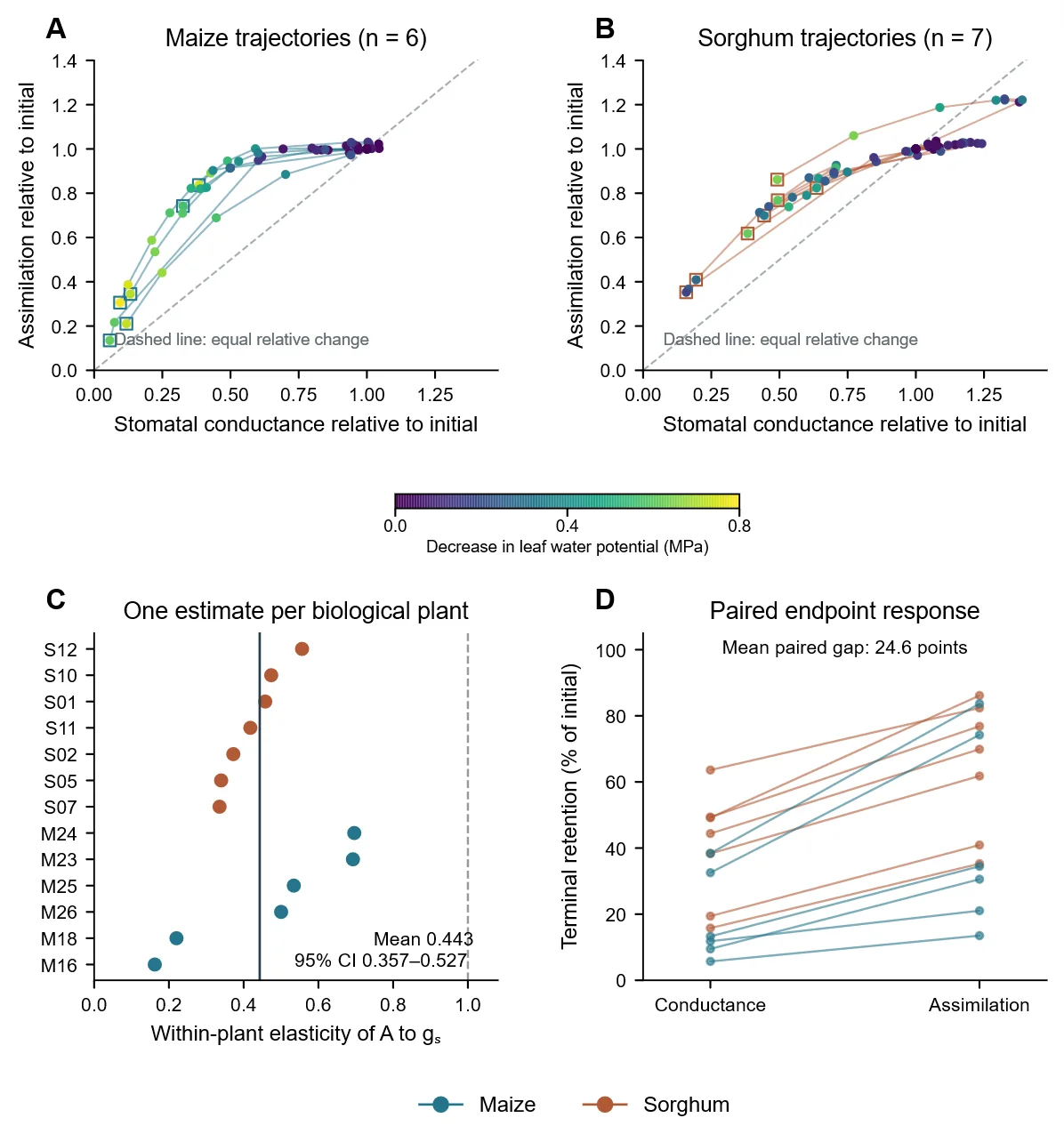
The analytical contribution is a synthesis, which is paired and scale aware. Both physiological trajectories and units of replication are presented together, as are plant level elasticities and profiles of plant management responses. The multipanel phase portrait clearly shows whether this retention of assimilation or conductance takes place at the individual plant level. Not a first discovery of dehydration sensitivity, a systematic review or demonstration of an improvement in an engineered crop.
4. Materials and Methods
4.1. Study design and data eligibility
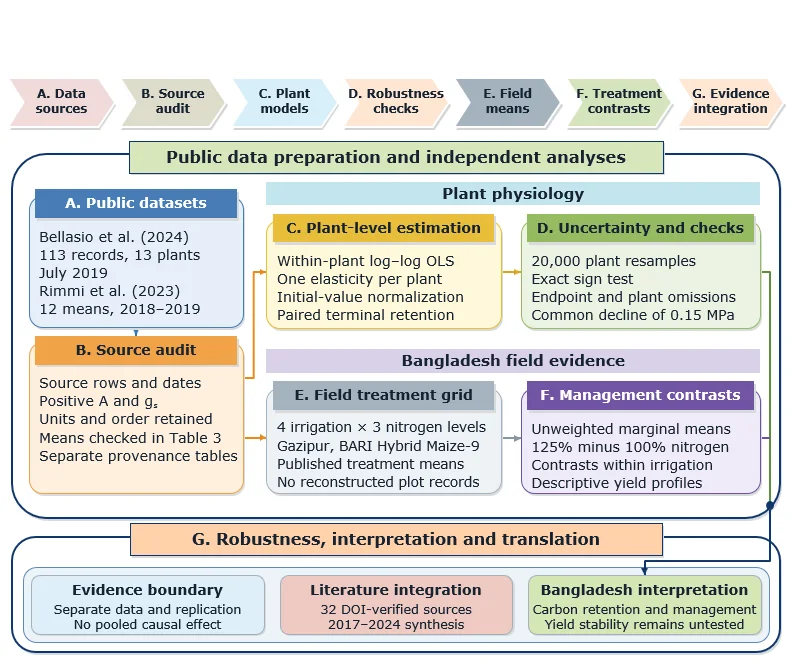
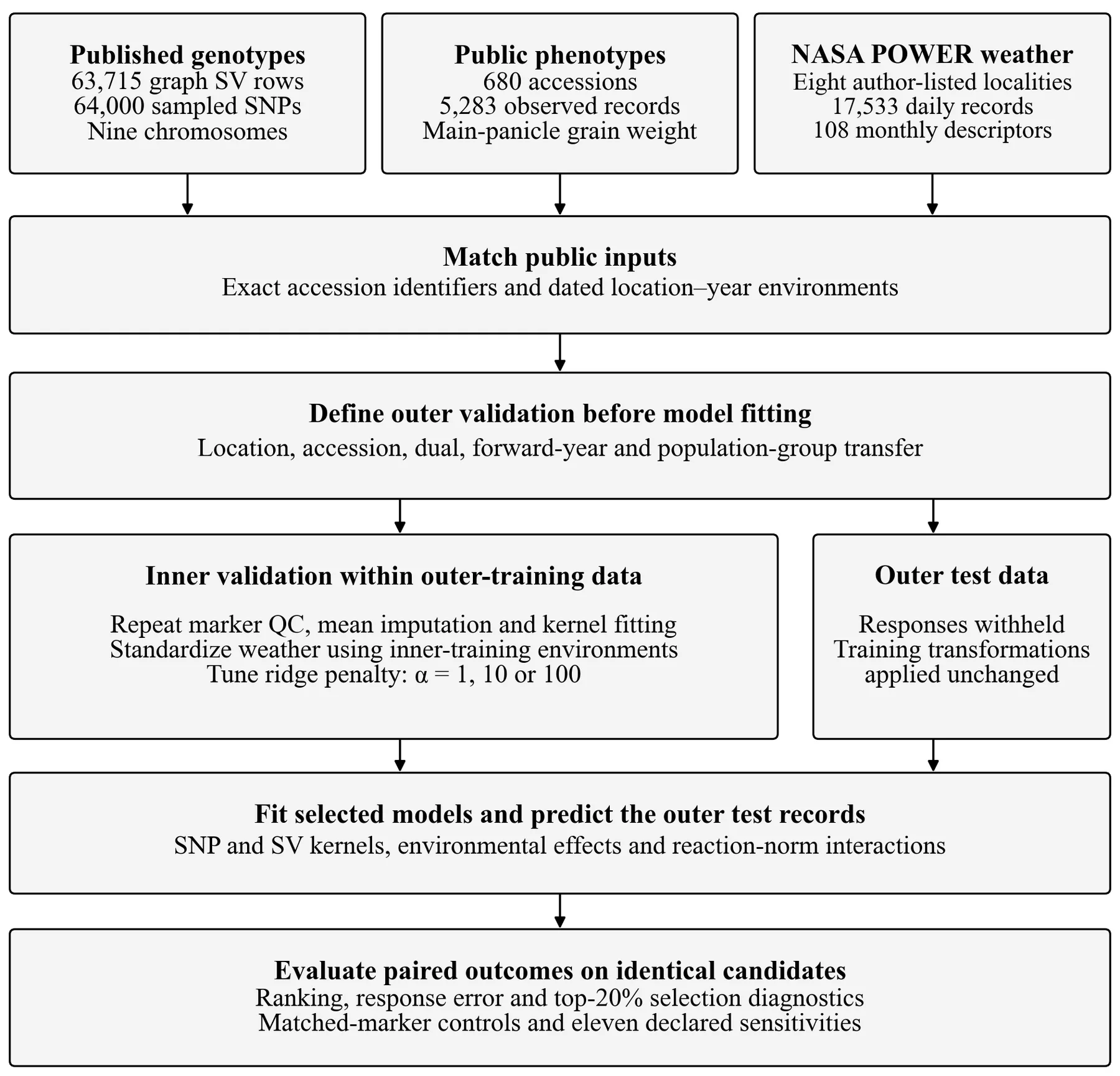
The choice of 2 public sources was made as they provided directly recoverable numerical data and identifiable experimental units and collection dates of 1/01/2017 to 31/12/2024. The physiological source was taken from Dataset S1 of Bellasio et al. (2024), which is freely available in the public article supplement (Bellasio et al., 2024). The agronomic source was Table 3 of Rimmi et al. (2023) and compared to the published PDF and public table image (Rimmi et al., 2023). No observation outside the requested collection window was taken and entered in the numerical analysis. There was no pooling, no merging of the two sources into a common regression and no experimental replication of one source by the other. The workflow is summarised in Figure 1.
4.2. Physiological measurements and audit
Hydroponically-grown maize and sorghum with progressive root exposure were used for the source experiment. Dataset dates were 1–26 July 2019. At each measurement time, one biological plant was identified as did in the source where six sorghum plants and seven maize
plants were identified each day. The data of ambient oxygen, leaf water potential, conductance and assimilation were analysed as well as the PSII yield. Other parts of the supplement (e.g. low oxygen content, isotope determination) are not reanalysed here. The irradiance during measurement was 500 μmol photons m⁻² s⁻¹, and the reference carbon dioxide was 300 μmol mol⁻¹, which limits the interpretation of the data obtained from the outside.
Note. The physiological and Bangladesh field datasets were analysed independently. The final integration is an interpretation alongside DOI-verified literature, not a pooled experiment. Source data: Bellasio et al. (2024) and Rimmi et al. (2023). All 113 records contained positive assimilation and conductance values and nonmissing values for the four focal variables. A total of 54 observations were made on maize and 59 observations on sorghum, and 6-11 measurements were made on each plant. The recorded leaf temperature was between 25.49 °C to 28.07 °C. The order of plants within each sequence was maintained. If there was repeated or nonmonotonic water-potential values, these were not dropped as it would
impose a nonmonotonic response. Row numbers and dates from the source were also captured with the data, providing traceability.
4.3. Plant-level estimation and uncertainty
Let A⁻⁻ denote assimilation and g⁻⁻ denote stomatal conductance for observation j on plant i. Ordinary least squares was used separately within each plant to estimate:
The Coefficient β⁻: a descriptive elasticity of a dimensionless nature. Any value less than one means that the assimilation does not change as much as the conductance for that plant throughout its observed path. The intercept was not presized and no regression p values were employed per observation for the purpose of biological inference. There was no difference in the weights of plants when the trajectory lengths were unequal: the total estimate was the arithmetic mean for the 13 plant coefficients. Species summaries were descriptive; experiment was not randomized across species for measurement dates. The plant coefficients were resampled with replacement 20,000 times using random seed 20241031. The shaded regions were 95% intervals.
Species intervals resampled within species. An exploratory two-way exact sign test was used to assess if the fraction of coefficients below 1 was different from 1/2. This test is not a test of a stomatal causal effect and is related to direction of plant-level departures. Bootstrap intervals are based on variations between the individual trajectories that are sampled and do not include all instrument uncertainty and uncertainty in each of the fitted parameters. Each measurement was divided by the first recorded measurement from its plant, for visualization. The value of "terminal retention" was the final value recorded divided by the first value recorded. The paired terminal gap was the difference between the assimilation retention and the conductance retention, in percentage points.
Plants were resampled as complete pairs when calculating its interval. The final observation is not a typical water potential or a proven lethal level. Three sensitivity checks were carried out. First, the regressions were refitted with the last observation eliminated from each plant, and then the last 2 observations were eliminated from each plant. Second, the pooled mean was computed without the information from each plant
individually. Third, the leaf water potential was assumed to decrease by 0.15 MPa between the initial measurements and the time of interpolation of assimilation and conductance retention. This interpolation was conducted on duplicate water-potential values which have been averaged, and no extrapolation was allowed. The threshold was selected based on the inspection of typical data coverage and hence the analysis is explicitly exploratory. If the trajectory is nonmonotonic then it is an interpolation of the response rather than a fitted trajectory of dehydration.
4.4. Bangladesh field data and contrasts
BARI Hybrid Maize-9 was tested in the Gazipur area from November 2018 to April 2019 and under Madhupur Tract soil condition. It went over four irrigation triggers of 20%, 40%, 60% and 80% available water, and with nitrogen at 75%, 100% and 125% of the recommended rate. Three randomized blocks were used in the original study, whereas the public numerical material used here provides 12 means of treatment rather than 36 means of grain yield per plot (Rimmi et al., 2023). All 12 measurements of grain yield were written and compared independently with the source table. The percentages of irrigation water were not translated to percentages of season water used, they were used as the source's trigger labels. It is important to note that the unweighted marginal means were calculated over the balanced treatment grid. A within-irrigation nitrogen contrast was the difference between the yields of the 125% N and 100% N treatments, with the 100% N treatment serving as the denominator. New analysis of variance, treatment confidence intervals or significance letters were not created. The published inferential results were not re- labeled as results from the present reanalysis.
4.5. Literature verification and reproducibility
The contextual literature was a purposive synthesis of literature published between 2017–2024. No attempts were made to conduct an exhaustive search or a meta-analysis, nor was a pooled engineering effect calculated. Primary publication information and a registered DOI record were checked for each of 32 references. Due to the fact that the published article retained the 2022 online-publication details for the DOI, the 2023 issue year, volume and pages were taken directly from the published article. The dataset dates, publication dates and retrieval date are separate fields in the provenance record.
A spreadsheet was extracted and every secondary statistic reported and the figures were generated by python scripts. The source linked observations, treatment means, plant summaries, numerical results and reference audit and editable SVG figures are included in the accompanying package. Physiological and field data are not combined and remain separate. These tables are used to get all the numerical figures and no simulated observations or reconstructed replicates were added.
5. Results
5.1. Physiological coupling at the plant level
The 13 individual elasticity estimates ranged from 0.162 to 0.696, with a mean of 0.443 (SD = 0.160; 95% bootstrap CI [0.357, 0.527]). Each estimate was below one and the exploratory exact sign-test result was p = .000244. This result implies a more uniform decrease in the assimilation rate as a proportion of the rate of stomatal conductance as plotted along these trajectories. It does not mean there was no change in assimilation, nor that there was no other process besides conductance that controlled assimilation. The maize mean elasticity was 0.468 [0.300, 0.635], and the sorghum mean was 0.422 [0.370, 0.479]. In this small sample, the individual maize values were more spread out. Such statements of a species difference do not exist in these summaries as the species were measured at different times and under different terminal water potentials. The complete within-plant paths are shown in figure 2, and each biological plant has its own coefficient instead of 113 coefficients being presented as 113 independent replicates. The key measures of the plant-level summaries are presented in Table 1.
Table 1 Plant-level physiological summaries
Measure Maize (n = 6)
Sorghum (n = 7)
All plants (n = 13)
Elasticity, mean 0.468 0.422 0.443
Elasticity, 95% CI [0.300, 0.635] [0.370, 0.479] [0.357, 0.527]
Initial A, μmol m⁻² s⁻¹ 19.7 22.6 21.3
Terminal A retention, % 42.9 64.7 54.7
Terminal g⁻ retention, % 18.5 40.0 30.1
Paired retention gap, points 24.4 24.7 24.6
Note. A = assimilation; g⁻ = stomatal conductance. Confidence intervals are percentile bootstrap intervals from 20,000 resamples of plants. Terminal values are relative to each plant’s first observation and do not represent a common terminal water potential.
Note. Color indicates the loss in leaf water potential from the first measurement in panels A and B, which preserve the order in which the measurements were taken within each plant. Final observations are indicated by open squares. Dashed diagonal shows equal relative values. In panel C the value of elasticity is displayed per plant as well as the pooled mean as a solid line. M and S indicate the day of maize and sorghum measurement, then followed by the day of measurement in July. The paired terminal conductance and assimilation retention for each plant is related for the panel D. The Bootstrap confidence interval is not for each row, but for all plants. This is a reanalysis of Bellasio et al. (2024), Dataset S1.
5.2. Terminal retention and sensitivity
For all plants, terminal assimilation was 54.7% of the first recorded value and conductance was
30.1% of the first recorded value. All the 13 gaps were positive and the paired retention gap was
24.6 percentage points [19.0, 30.6]. The average value of the PSII yield in the terminals was
64.9% of the initial value. The results indicate that some of the measured processes were retained
to a greater extent than others during the drying, and considerable loss in assimilation still
remains.
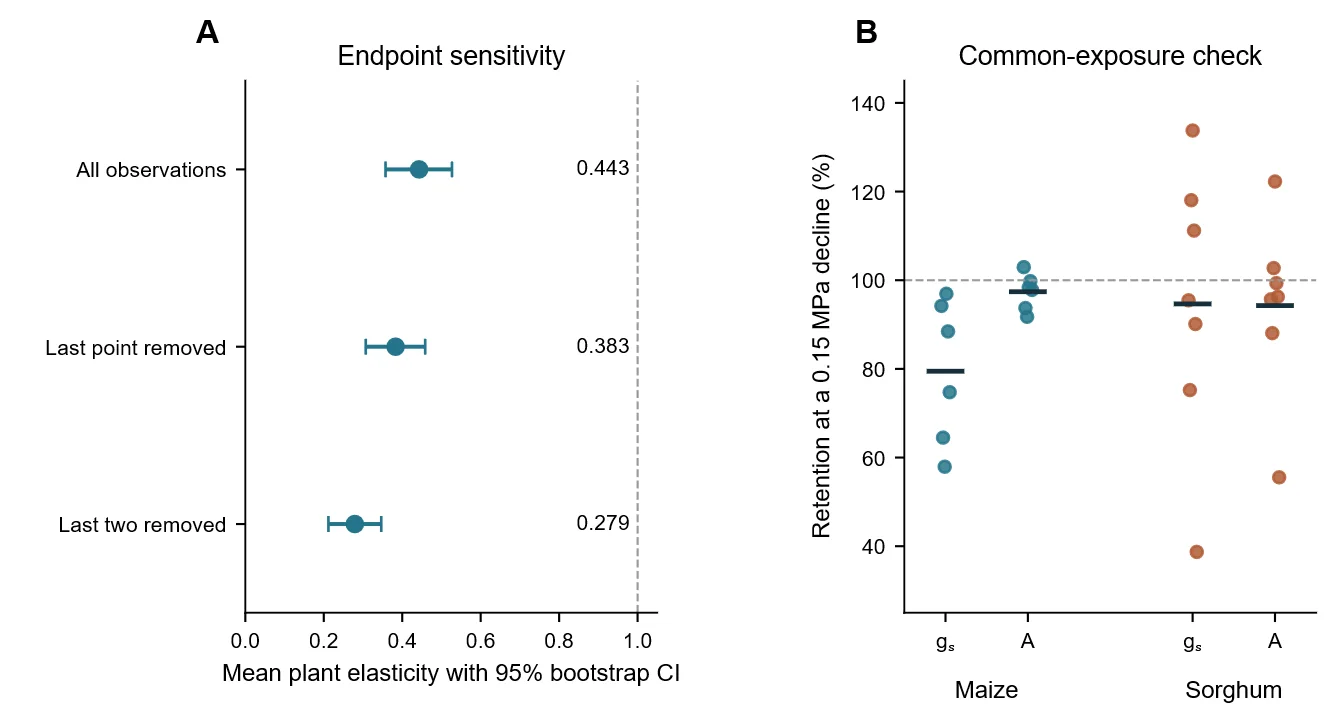
Removing the last observation for each plant reduced the average elasticity to 0.383 [0.307,
0.459] and removing the last two observations for each plant further reduced the average
elasticity to 0.279 [0.212, 0.347]. The direction of the asymmetry of the assimilation and
conductance thus remained, but the size of the asymmetry varied depending on the portion of the
dehydration series which was included. The 100 data points pooled average (L100) was in the
range of 0.422 - 0.466, so no single plant was the sole contributor to the average result.
At the common 0.15 MPa decline, mean assimilation retention was 95.7% [87.7, 102.6], and
mean conductance retention was 87.6% [74.1, 100.8]. A few normalized values were higher than
100% which was due to readings that were higher than the initial reading in the beginning. The
wide range of intervals and the nonmonotonic responses make extrapolation to the onset of
dehydration a warning. This common-exposure check, along with a completed endpoint
sensitivity analysis, is shown in Figure 3.
Note. Panel A shows means and 95% percentile bootstrap intervals for plant-level elasticities, using all measurements and then excluding the final one or two measurements per plant. Panel B shows normalized assimilation (A) and conductance (g⁻) interpolated at a 0.15 MPa decline; each dot is a plant and each black segment is a species mean. Values above 100% reflect increases relative to the first measurement. Reanalysis of Bellasio et al. (2024), Dataset S1.
5.3. Bangladesh grain-yield responses
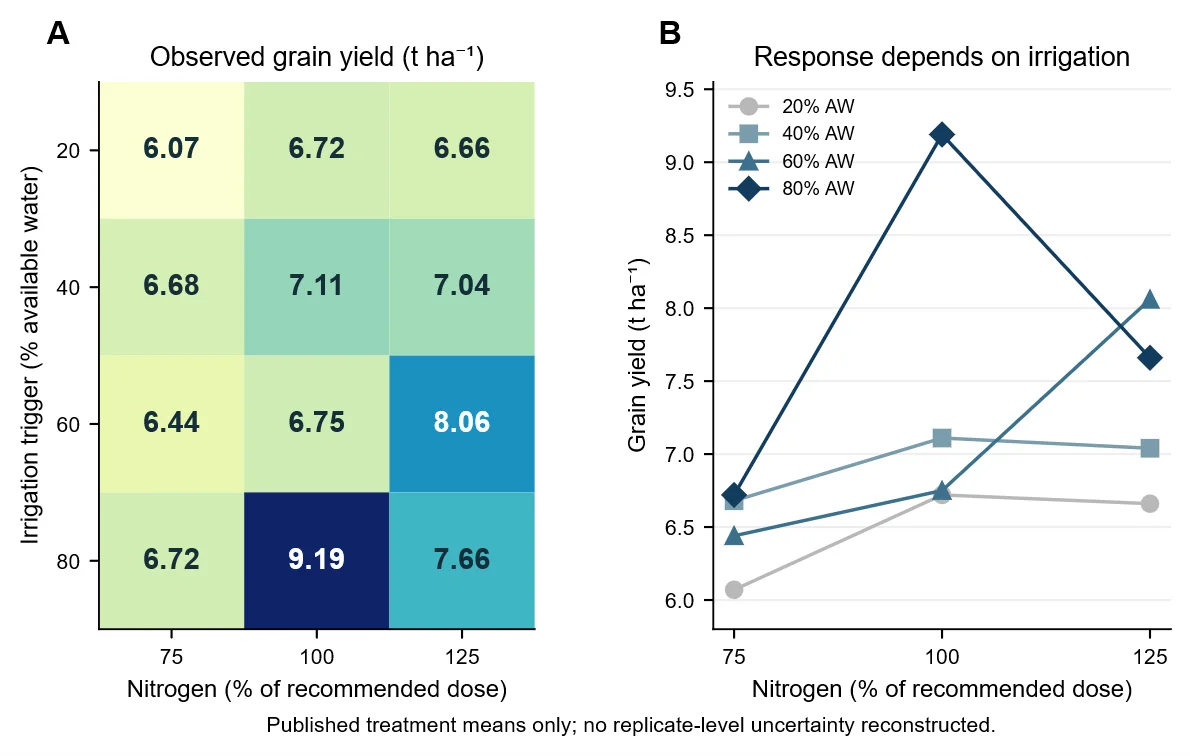
The range of the 12 field treatment was from 6.07 to 9.19 t ha⁻¹. The mean values of these
marginal conditions were calculated as 6.48, 6.94, 7.08 and 7.86 t ha-1 at the 20%, 40%, 60%
and 80% available-water triggers, respectively. Marginals did not differ between irrigation
treatments at 6.48, 7.44 and 7.36 t ha⁻¹ at 75%, 100% and 125% of recommended nitrogen. In
Figure 4, all means of the treatments are shown and not just these marginals.
Note. Panel A shows all 12 published grain-yield means. Panel B connects those same means across nitrogen levels within irrigation categories. AW = available water; irrigation percentages identify trigger treatments and are not percentages of seasonal water supplied. Lines aid comparison and do not represent fitted continuous response functions. No new uncertainty intervals or significance tests were assigned to the rounded treatment means. Source: Rimmi et al. (2023), Table 3; field season 2018–2019.
At 100% nitrogen, the 80% trigger had a mean yield of 9.19 t ha⁻¹ compared with 6.72 t ha⁻¹ at
the 20% trigger, a descriptive difference of 2.47 t ha⁻¹ or 36.8%. Note: The figures are for
irrigation-treatment comparison, and not an estimate of yield response per unit of irrigation water
applied. No reconstruction of the volume of water required for seasonal irrigation.
N response varied between irrigation categories. Nitrogen rates of 100% to 125% of the
recommended dose resulted in a decrease of −0.06, −0.07, plus an increase of +1.31
and minus an increase of −1.53 t ha⁻¹ at the four irrigation triggers, respectively. The
latter two contrasts were +19.4% and −16.6%, respectively. The opposing signs are
seen in the treatment profiles, but not statistically significant in this reanalysis. This
observed management dependency would be masked by a marginal recommendation based on N only.
5.4. Boundaries of the combined evidence
The two analyses were complementary in addressing the two questions. Repeated leaf response to fast water deficit was quantified through physiological data. The quantified realized grain yield under irrigation and N management in one season of a field is the Bangladesh treatment. No common genotype, location, experimental treatment, or associated plant-to-plot record that could be used to construct a causal model that could link the two. Both data sets did not provide a multi-year stability metric, a manipulated heat contrast, a fluctuating-light response curve or a newly engineered C4 line. The following outcomes were then not estimated.
6. Discussion
6.1. What the carbon–conductance asymmetry means
The plant-level analysis confirms that the narrow result here is useful: assimilation varied less proportionately than stomatal conductance along the dehydration trajectories observed. The difference existed in all plants and persisted even following the removal of severe endpoints. The average slope was smaller in the absence of the terminal measurements, however. Therefore, only one coefficient condenses a response with a balance that changes over the course of the dehydration series. To interpret the pooled summary, the complete paths in figure 2 are required. This pattern is consistent with carbon assimilation being buffered for a portion of the conductance range but does not distinguish the mechanism of carbon assimilation buffering. The two main components of assimilation and conductance are measured via the same gas-exchange system, and may exhibit correlated errors, and both are sensitive to water status and internal metabolism. The original study on bundle sheath conductance employed information other than that analysed here (Bellasio et al., 2024). We are unable to distinguish between the stomatal limitation, intercellular transport, biochemical feedback and energy supply. The defensible engineering implication is that these processes should be measured concurrently, not as target gene effects. Initial-value normalization also shows a practical problem. Multiple trendlines went above their initial level then fell. An exclusive terminal retention plot would mask those early changes. The
common-exposure analysis was therefore particularly helpful as it demonstrated that the average assimilation was also relatively well retained for relatively low levels of water-potential decline, and uncertainty in both normalized responses was remained significant. This is important when an engineering treatment is not designed to stall or hold off significant loss, but to continue the increase of carbon.
6.2. Why water saving and heat tolerance must be distinguished
An increase in the leaf level assimilation-to-conductance ratio can be obtained when the leaf- level assimilation increases and the conductance decreases, while the assimilation is relatively retained. This mathematical transformation is not evidence of increased seasonal water productivity. Not specific to total transpiration, crop duration, soil evaporation or reproductive success or grain filling. It excludes also the cooling effect of transpiration. This range of measured leaf temperature in the reanalysed data was insufficient, and the treatment design was too restricted, to assess heat tolerance. Combined-stress sorghum experiments provide evidence of conductance being related to the conflicting roles of water conservation and thermoregulation (Al-Salman et al., 2023). Maize studies also reveal that heat and drought must be treated together, and that under heat stress, the temperature of the canopy can change when irrigation is applied (Hu et al., 2023; Jian et al., 2024). These observations are the reason why a C4 engineering strategy, which is only required in lower conductance, has the possibility of having an uncertain impact in a hot field. They do not make a universal claim that higher conductance is good. The outcome relevant is carbon gain and reproductive performance at the present water supply/atmospheric demand combination.
6.3. What multi-omics can add to an empirically anchored interpretation
Physiological result indicates a problem of coordination; multi-omics can be used to find the steps of regulation involved. The C4 system distributes functions between mesophyll and bundle sheath tissues, so cell-type resolution is necessary. One bulk expression profile is not enough to describe a system, as evidenced by chromatin, transcript and translation measurements, and by time-of-day effects (Borba et al., 2023; Chotewutmontri & Barkan, 2021; Dai et al., 2022). This work does not reanalyse sequencing files or report differential genes. It is up to it to provide the physiological quantities that would require explanation before a molecular association can back up an engineering claim.
There is also a hierarchy of evidential strength in the engineering literature. Having a gene in existence or expression means that it's a possible element, protein accumulation means another step, and carbon flux means a more direct indication of function. These steps cannot be collapsed; as shown in rice expressing C4 enzymes and in the assembly of Rubisco in a non- native compartment within maize.These steps can not be collapsed, as illustrated by the rice expressing C4 enzymes and the assembly of Rubisco in a non-native compartment within maize. Targeted improvement of Rubisco assembly and electron transport reveal other constraints on native C4 capacity, and anatomical analysis indicates further constraints and complexity (Ermakova et al., 2019; Salesse-Smith et al., 2018; Vlad et al., 2024). The implications for Bangladesh are thus, not that a particular transgene has already stabilised local maize or rice production, but rather, about target evaluation and transferability.
6.4. Dynamic-light relevance and limits
Photosynthetic induction and recovery from photoprotection cannot be quantified by the present dehydration series due to constant irradiance during the focal measurements. However, its carbon–conductance asymmetry provides a tangible motivation to not extrapolate steady-state relationships into a fluctuating canopy. The kinetics of assimilation and stomatal response are different and the delays between them are explicitly treated in the dynamic C4 model (Y. Wang et al., 2021). The relative importance of these processes also varies with the environment as seen in comparative induction and maize humidity experiments (Shi et al., 2024; Tanigawa et al., 2024). For this soybean photoprotection study, a dynamic photosynthetic intervention was able to achieve a crop yield endpoint under field conditions (De Souza et al., 2022). It does not provide a yield multiplier for the C4 maize. Similarly, under variable light, PSI photoinhibition shows a vulnerability that does not occur in a photoinhibition–assimilation–conductance regression ( Yang et al., 2024). A good translation is then a blend of several types of evidence, but still carries along the crop, treatment, measurement conditions associated with each.
6.5. Bangladesh management and the meaning of field validation
The Gazipur is to demonstrate that a physiological gain needs to be assessed in the context of an agronomic treatment. The same rise in N resulted in opposite yield changes at irrigation triggers of 60% and 80%. Such a description does not provide any evidence for a universal optimum or
significance claim, but it does indicate that if the water treatments are averaged, practically relevant variation in the published mean may be present. The greatest yield in the treatment grid is not necessarily a measure of the stability. For stability, observations must be made over environments, seasons or explicitly repeated stresses and a statement of stable performance must be made. It is impossible for any one treatment grid to separate out the effects of broad adaptation from a favorable response to treatment for any one season. The available field study thus is of assistance in providing evidence of local management but not a physiological mechanism that was measured in other plants in other locations. Given the context of South Asia, there is a locally relevant path to assessing the transfer of physiological traits to adapted germplasm in maize (Zaidi et al., 2023). Photosynthetic engineering and agronomic management should be evaluated in that regional evidence base, taking into account environmental variability and the demand for crops in the interpretation (Matthews & Burgess, 2024). The present results justify a particular judgement: the need to take a particular stand on the issue of joint evaluation of carbon retention, cooling and management response as well as reserve a yield-stability claim for data that truly measure yield stability.
7. Limitations
The physiological sample contained 13 plants and one rapid-dehydration protocol. It was not a random sample of maize or sorghum germplasm. Species and measurement date were correlated; species summaries cannot separate genetic differences. Variations in final retention also make it difficult to use the final retention as a measure of the same stress intensity. This does not resemble progressive soil drying in a field as is the case with root exposure over hours. Within plant regressions are association regressions. They have not been able to model errors in both coordinates explicitly or model the autocorrelation in repeated measurements or for changing biochemical limitation. Resampling plants provides no independent biological replication but the intervals are still conditional on the fitted plant summaries. In the endpoint- deletion analysis, the number of observations is modified, as is also the physiological range of observations. Its outcomes indicate sensitivity instead of a uniquely proper coefficient. The common-exposure threshold was chosen as a result of evaluating the coverage and is not to be interpreted as a prespecified physiological breakpoint.
Rounded treatment means were available for the Bangladesh analysis, but the plot-level yield data were not available. So there was no need to take the risk of recommending new residual variance estimates, confidence intervals, interaction tests, etc. Water productivity, economic returns or nitrogen losses were not estimated. The results of its findings are applicable for the published treatment grid, and not applicable to a national response surface. Literature was synthesized in a purposeful fashion and limited to articles in the desired 2017- 2024 timeframe. A DOI is valid evidence of source identity, not of the quality of the study or its possible replicability. The synthesis does not claim to be a comprehensive review of the evidence and does not cover subsequent developments. Most importantly, no new engineering, multi- omics assay, heat experiment, dynamic-light experiment or multi-environment field validation was performed. Although the scope of the title is broader than the conclusions drawn are, these boundaries limit the conclusions.
8. Conclusion
In the 13 maize and sorghum plants, reanalysis of publicly available measurements from 2019 indicated that assimilation changed to a lesser extent than stomatal conductance. The mean value of elasticity was 0.443, but its value decreased after removal of severe endpoints, indicating that the carbon–conductance coordination is not uniform along the dehydration trajectory. However, opposite nitrogen contrasts at two irrigation triggers and management-dependent grain-yield responses were found independently in the Bangladesh field database. The completed outcomes contribute to assessing photosynthetic characteristics in terms of their water, thermal and nutrient context. They do not create an engineered yield gain or multi-year stability. A reproducible link between individual plant response geometry, valid biological replication and local field treatment evidence is the main contribution. Multi-omics and dynamic-light research provide insight into why molecular regulation and developmental anatomy and response timing should be included when interpreting, whereas the data set the boundary of what can be currently claimed. There is a need to have evidence for Bangladesh: A desirable photosynthetic trait should persist in adapted germplasm under management and environmental conditions that can shape grain yield.
9. Data and Code Availability
The physiological observations are publicly available in Dataset S1 accompanying Bellasio et al. (2024), https://doi.org/10.1111/nph.20167. The Bangladesh grain-yield means are publicly available in Table 3 of Rimmi et al. (2023), https://doi.org/10.18805/ag.DF-493. The accompanying reproducibility package contains extracted observation tables, all 12 field means, plant-level estimates, numerical summaries, scripts and source provenance. Figures 1–4 are supplied as editable SVG vector graphics and as editable presentation masters. Original source reuse terms apply.
References
Al-Salman, Y., Ghannoum, O., & Cano, F. J. (2023). Elevated [CO2] negatively impacts C4 photosynthesis under heat and water stress without penalizing biomass. Journal of Experimental Botany, 74(9), 2875–2890. https://doi.org/10.1093/jxb/erad063 Bellasio, C., Quirk, J., Buckley, T. N., & Beerling, D. J. (2017). A dynamic hydro-mechanical and biochemical model of stomatal conductance for C4 photosynthesis. Plant Physiology, 175(1), 104–119. https://doi.org/10.1104/pp.17.00666 Bellasio, C., Stuart-Williams, H., Farquhar, G. D., & Flexas, J. (2023). C4 maize and sorghum are more sensitive to rapid dehydration than C3 wheat and sunflower. New Phytologist, 240(6), 2239–2252. https://doi.org/10.1111/nph.19299 Bellasio, C., Stuart-Williams, H., Farquhar, G. D., & Flexas, J. (2024). Fast dehydration reduces bundle sheath conductance in C4 maize and sorghum. New Phytologist, 244(6), 2197–2209. https://doi.org/10.1111/nph.20167 Borba, A. R., Reyna-Llorens, I., Dickinson, P. J., Steed, G., Gouveia, P., Górska, A. M., Gomes, C., Kromdijk, J., Webb, A. A. R., Saibo, N. J. M., & Hibberd, J. M. (2023). Compartmentation of photosynthesis gene expression in C4 maize depends on time of day. Plant Physiology, 193(4), 2306–2320. https://doi.org/10.1093/plphys/kiad447 Chen, L., Yang, Y., Zhao, Z., Lu, S., Lu, Q., Cui, C., Parry, M. A. J., & Hu, Y.-G. (2023). Genome-wide identification and comparative analyses of key genes involved in C4 photosynthesis in five main gramineous crops. Frontiers in Plant Science, 14, Article 1134170. https://doi.org/10.3389/fpls.2023.1134170
Chotewutmontri, P., & Barkan, A. (2021). Ribosome profiling elucidates differential gene expression in bundle sheath and mesophyll cells in maize. Plant Physiology, 187(1), 59–72. https://doi.org/10.1093/plphys/kiab272 Dai, X., Tu, X., Du, B., Dong, P., Sun, S., Wang, X., Sun, J., Li, G., Lu, T., Zhong, S., & Li, P. (2022). Chromatin and regulatory differentiation between bundle sheath and mesophyll cells in maize. The Plant Journal, 109(3), 675–692. https://doi.org/10.1111/tpj.15586 De Souza, A. P., Burgess, S. J., Doran, L., Hansen, J., Manukyan, L., Maryn, N., Gotarkar, D., Leonelli, L., Niyogi, K. K., & Long, S. P. (2022). Soybean photosynthesis and crop yield are improved by accelerating recovery from photoprotection. Science, 377(6608), 851–854. https://doi.org/10.1126/science.adc9831 Ermakova, M., Arrivault, S., Giuliani, R., Danila, F., Alonso-Cantabrana, H., Vlad, D., Ishihara, H., Feil, R., Guenther, M., Borghi, G.
L., Covshoff, S., Ludwig, M., Cousins, A. B., Langdale, J. A., Kelly, S., Lunn, J. E., Stitt, M., von Caemmerer, S., & Furbank, R. T. (2021). Installation of C4 photosynthetic pathway enzymes in rice using a single construct. Plant Biotechnology Journal, 19(3), 575–588. https://doi.org/10.1111/pbi.13487 Ermakova, M., Danila, F. R., Furbank, R. T., & von Caemmerer, S. (2020). On the road to C4 rice: Advances and perspectives. The Plant Journal, 101(4), 940–950. https://doi.org/10.1111/tpj.14562 Ermakova, M., Lopez-Calcagno, P. E., Raines, C. A., Furbank, R. T., & von Caemmerer, S. (2019). Overexpression of the Rieske FeS protein of the Cytochrome b6f complex increases C4 photosynthesis in Setaria viridis. Communications Biology, 2(1), Article 314. https://doi.org/10.1038/s42003-019-0561-9 Furbank, R., Kelly, S., & von Caemmerer, S.
(2023). Photosynthesis and food security: The evolving story of C4 rice. Photosynthesis Research, 158(2), 121–130. https://doi.org/10.1007/s11120-023-01014-0 Hernández-Verdeja, T., & Lundgren, M. R. (2024). GOLDEN2-LIKE transcription factors: A golden ticket to improve crops? Plants, People, Planet, 6(1), 79–93. https://doi.org/10.1002/ppp3.10412
Hotto, A. M., Salesse-Smith, C., Lin, M., Busch, F. A., Simpson, I., & Stern, D. B. (2021). Rubisco production in maize mesophyll cells through ectopic expression of subunits and chaperones. Journal of Experimental Botany, 72(13), 4930–4937. https://doi.org/10.1093/jxb/erab189 Hu, J., Zhao, X., Gu, L., Liu, P., Zhao, B., Zhang, J., & Ren, B. (2023). The effects of high temperature, drought, and their combined stresses on the photosynthesis and senescence of summer maize. Agricultural Water Management, 289, Article 108525. https://doi.org/10.1016/j.agwat.2023.108525 Jian, H., Gao, Z., Guo, Y., Xu, X., Li, X., Yu, M., Liu, G., Bian, D., Cui, Y., & Du, X. (2024). Supplemental irrigation mitigates yield loss of maize through reducing canopy temperature under heat stress.
Agricultural Water Management, 299, Article 108888. https://doi.org/10.1016/j.agwat.2024.108888 Liu, Z., & Cheng, J. (2024). C4 rice engineering, beyond installing a C4 cycle. Plant Physiology and Biochemistry, 206, Article 108256. https://doi.org/10.1016/j.plaphy.2023.108256 Long, S. P., Taylor, S. H., Burgess, S. J., Carmo-Silva, E., Lawson, T., De Souza, A. P., Leonelli, L., & Wang, Y. (2022). Into the shadows and back into sunlight: Photosynthesis in fluctuating light. Annual Review of Plant Biology, 73(1), 617–648. https://doi.org/10.1146/annurev-arplant-070221-024745 Ma, B., Zhang, Y., Fan, Y., Zhang, L., Li, X., Zhang, Q.-Q., Shu, Q., Huang, J., Chen, G., Li, Q., Gao, Q., Zhu, X.-G., He, Z., & Wang, P. (2024). Genetic improvement of phosphate-limited photosynthesis for high yield in rice.
Proceedings of the National Academy of Sciences, 121(34), Article e2404199121. https://doi.org/10.1073/pnas.2404199121 Matthews, M. L., & Burgess, S. J. (2024). How much could improving photosynthesis increase crop yields? A call for systems-level perspectives to guide engineering strategies. Current Opinion in Biotechnology, 88, Article 103144. https://doi.org/10.1016/j.copbio.2024.103144 Perico, C., Zaidem, M., Sedelnikova, O., Bhattacharya, S., Korfhage, C., & Langdale, J. A. (2024). Multiplexed in situ hybridization reveals distinct lineage identities for major and minor vein initiation during maize leaf development. Proceedings of the National Academy of Sciences, 121(28), Article e2402514121. https://doi.org/10.1073/pnas.2402514121
Plackett, A. R. G., & Hibberd, J. M. (2024). Rice bundle sheath cell shape is regulated by the timing of light exposure during leaf development. Plant, Cell & Environment, 47(7), 2595–2611. https://doi.org/10.1111/pce.14902 Rimmi, S. N., Islam, M. S., Alam, M. S., Khan, M. A. R., & Binte, B. I. (2023). Yield response of maize to irrigation and nitrogen fertilization. Agricultural Science Digest, 43(5), 649–654. https://doi.org/10.18805/ag.df-493 Salesse-Smith, C. E., Sharwood, R. E., Busch, F. A., Kromdijk, J., Bardal, V., & Stern, D. B. (2018). Overexpression of Rubisco subunits with RAF1 increases Rubisco content in maize. Nature Plants, 4(10), 802–810. https://doi.org/10.1038/s41477-018-0252-4 Shi, Q., Wang, X.-Q., He, B., Yang, Y.-J., & Huang, W.
(2024). Differential impact of decreasing relative humidity on photosynthesis under fluctuating light between maize and tomato. Physiologia Plantarum, 176(1), Article e14179. https://doi.org/10.1111/ppl.14179 Tanigawa, K., Yuchen, Q., Katsuhama, N., Sakoda, K., Wakabayashi, Y., Tanaka, Y., Sage, R., Lawson, T., & Yamori, W. (2024). C4 monocots and C4 dicots exhibit rapid photosynthetic induction response in contrast to C3 plants. Physiologia Plantarum, 176(4), Article e14431. https://doi.org/10.1111/ppl.14431 Vlad, D., Zaidem, M., Perico, C., Sedelnikova, O., Bhattacharya, S., & Langdale, J. A. (2024). The WIP6 transcription factor TOO MANY LATERALS specifies vein type in C4 and C3 grass leaves. Current Biology, 34(8), 1670–1686.e10. https://doi.org/10.1016/j.cub.2024.03.007 Wang, P., Khoshravesh, R., Karki, S., Tapia, R., Balahadia, C. P., Bandyopadhyay, A., Quick, W.
P., Furbank, R., Sage, T. L., & Langdale, J. A. (2017). Re-creation of a key step in the evolutionary switch from C3 to C4 leaf anatomy. Current Biology, 27(21), 3278–3287.e6. https://doi.org/10.1016/j.cub.2017.09.040 Wang, Y., Chan, K. X., & Long, S. P. (2021). Towards a dynamic photosynthesis model to guide yield improvement in C4 crops. The Plant Journal, 107(2), 343–359. https://doi.org/10.1111/tpj.15365 Yang, Q.-Y., Wang, X.-Q., Yang, Y.-J., & Huang, W. (2024). Fluctuating light induces a significant photoinhibition of photosystem I in maize. Plant Physiology and Biochemistry, 207, Article 108426. https://doi.org/10.1016/j.plaphy.2024.108426
Zaidi, P. H., Vinayan, M. T., Nair, S. K., Kuchanur, P. H., Kumar, R., Singh, S. B., Tripathi, M. P., Patil, A., Ahmed, S., Hussain, A., Kulkarni, A. P., Wangmo, P., Tuinstra, M. R., & Prasanna, B. M. (2023). Heat-tolerant maize for rainfed hot, dry environments in the lowland tropics: From breeding to improved seed delivery. The Crop Journal, 11(4), 986–1000. https://doi.org/10.1016/j.cj.2023.06.008